
Most advice about insurance virtual assistants starts in the wrong place. It treats them like nicer chatbots, then wonders why the rollout stalls when a claim needs a handoff, a renewal needs policy context, or compliance needs a trail you can defend later.
In practice, the useful question isn't whether a virtual assistant can answer a policy question. It's whether it can move work through the policy lifecycle without breaking licensing rules, fragmenting data, or creating more manual cleanup than it removes.
Table of Contents
- Why Insurance Virtual Assistants Are More Than Chatbots
- Market Growth and Adoption Benchmarks
- Core Use Cases Across the Policy Lifecycle
- Compliance and System Integration Challenges
- Measuring ROI Beyond Labor Substitution
- Real Deployment Scenarios for Agencies
- Building Your Virtual Assistant Strategy
Why Insurance Virtual Assistants Are More Than Chatbots
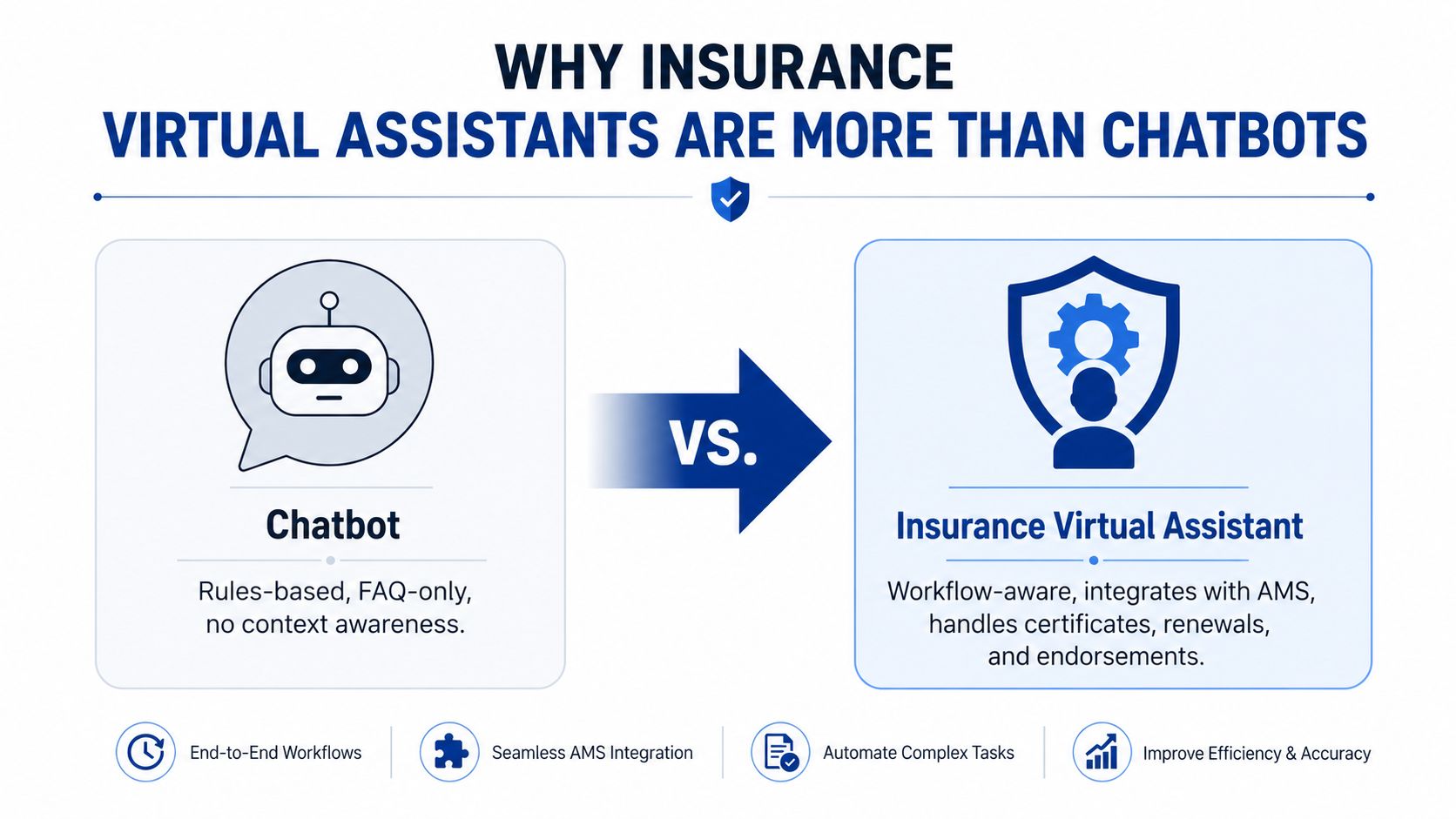
A chatbot answers. Insurance virtual assistants do work. That difference sounds small until you try to use one inside a real agency management system, where the assistant needs policy context, document status, escalation rules, and a clean record of what happened at each step.
That's why the strongest deployments look less like customer service widgets and more like workflow-aware agents. They can support submissions, renewals, endorsements, claims intake, and service requests by pulling data from downstream systems, validating fields, and routing exceptions to a licensed person before anything risky gets approved. The value is not in sounding human, it's in knowing what the next operational step should be.
What changes inside the workflow
A rules-based bot usually stops at FAQ handling, simple routing, or scripted intake. A workflow-aware assistant can follow context across multiple systems, which matters when a certificate request depends on policy status, a renewal depends on updated exposures, or a claim needs document classification before a human reviews the file.
The practical payoff is that the assistant becomes part of the operating model, not a side channel. It can collect details, check for missing fields, and hand off the exact exception instead of dumping a half-finished conversation into a service queue. That's also why resources like the Halo AI virtual assistant are useful to read as a technical comparison point, because the conversation is really about orchestration, not chat.
A good insurance assistant should reduce the number of times a licensed staff member has to re-ask the same question.
The more important distinction is where the assistant lives. If it only sits on the front end, you get a polite intake layer. If it reaches into the policy lifecycle, it starts functioning like operational infrastructure.
Market Growth and Adoption Benchmarks
Adoption has shifted from curiosity to operational expectation, especially where service and claims queues are overloaded. The insurance virtual assistants market was estimated at $3.8 billion in 2025 and is projected to reach $24.9 billion by 2034, a 22.4% CAGR according to Market Intel. Software accounted for 58.2% of the market in 2025, while Asia Pacific represented 38.5% of revenue. Those figures point to a defined technology category, not a minor feature added to a service platform.
Customer service adoption has also moved into routine operations. A 2026 industry summary reports that more than 70% of global insurers use AI chatbots for customer service, up from 45% in 2021. It also reports that these chatbots handle about 60% of routine inquiries and cut average resolution time by 50% WorldMetrics. The figures do not establish that every deployment performs well. They do show that insurers are testing a more specific question: which workflow should the assistant enter, and where must staff retain control?
What the market data actually implies
The strongest demand sits around intake, document handling, and repetitive policy servicing. These workflows have clear inputs, repeatable checks, and measurable queue delays. Subjective underwriting decisions remain a poor fit because they depend on context, authority, and accountability that an automated system may not possess.
Market growth also exposes an implementation gap. Agencies often purchase the software before mapping the work it must support. A front-end assistant can collect conversations while leaving staff to re-key information into a legacy management system, verify compliance requirements, and resolve exceptions manually. In that setup, adoption may look active while operational improvement remains limited.
Teams that map handoffs first can use the same technology more effectively. They define which system supplies the record, which fields require validation, which events trigger a human review, and which outcomes count as successful completion. The investment then has a measurable operating target rather than a broad promise to reduce service workload.
| Insurance VA Adoption Benchmarks by Agency Size | Agency Tier | VA Penetration Rate | Avg. Deployment Timeline | Transaction Automation % | Staffing Ratio Impact |
|---|---|---|---|---|
| Small independent agency | Low to moderate | Pilot phase | Limited to repetitive intake and routing | Modest relief for service staff |
| Mid-market agency | Higher relative uptake | Staged rollout | Workflow-specific automation across service lines | Broader reduction in manual touchpoints |
| Large carrier or brokerage | Selective deployment | Longer integration cycle | Targeted automation in high-volume queues | More emphasis on exception handling |
Core Use Cases Across the Policy Lifecycle
The most revealing test for insurance virtual assistants is what happens when a request reaches an exception. A useful deployment follows the work through policy administration, claims triage, and customer communications, while preserving compliance controls and clear human ownership.
Policy administration
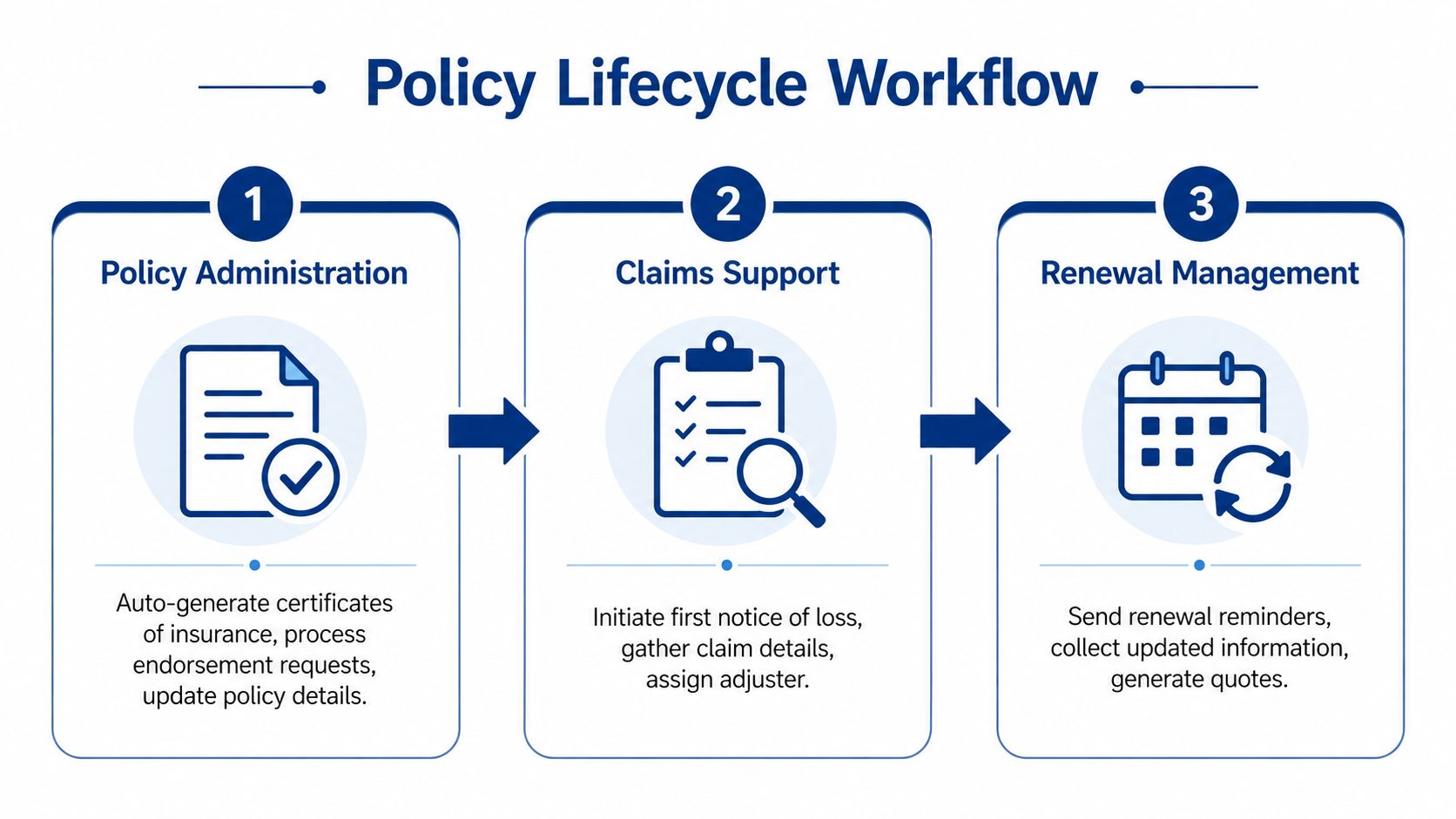
Policy administration is often the first place an assistant earns operational trust. It can process certificate requests, assemble endorsement packets, validate renewal data, and flag missing items before a file reaches a licensed reviewer. The assistant handles repetitive collection and formatting, while a person makes the judgment call.
The handoff needs explicit boundaries. A certificate of insurance can be prepared automatically, but a request involving coverage interpretation, wording exceptions, or unusual additional insured language still requires human review. For renewals, the assistant can gather updates and pre-fill records. A producer or account manager should own the final decision before anything is sent.
Keep the assistant on collection, validation, and routing. Keep licensed staff on interpretation and binding decisions.
Claims triage
Claims workflows expose the value of structured intake. Insurance virtual assistants can support first notice of loss, sort incoming submissions, and classify supporting documents so an adjuster does not begin with an empty screen. One effective pattern has the assistant ingest multi-format packets, extract structured fields, and route exceptions for human review V7 Labs.
That sequence assigns deterministic work to the system first. It can cross-reference policyholder data, apply OCR and NLP to unstructured narratives, and route files by severity or fraud signals before an adjuster reviews them. Reserve recommendations, coverage disputes, and claim decisions with financial or legal exposure remain human responsibilities.
Customer communications
Customer communication is often overestimated during deployment. An assistant can handle status updates, policy-change confirmations, billing questions, and authentication across voice and digital channels when the request is routine Rasa. It also needs a defined stop condition for coverage disputes, sensitive retention issues, and requests that require licensed judgment.
Consistency is the practical benefit. Each interaction follows the same intake structure, reducing missing information and giving service staff a cleaner queue. The assistant becomes a first-pass filter, so teams can spend more time on complex calls instead of repetitive status checks.
The operating result depends on integration. If staff must re-key every collected detail into a legacy system, the assistant has shifted effort rather than removed it. Measure completed workflow steps, exception quality, and handoff time alongside conversation volume.
Compliance and System Integration Challenges
Insurance automation operates inside licensing boundaries, audit requirements, and systems built before modern orchestration. The assistant needs narrow permissions, traceable actions, and defined human handoffs from the first deployment. Integration is an operational constraint, not a later technical detail.
Where the friction starts
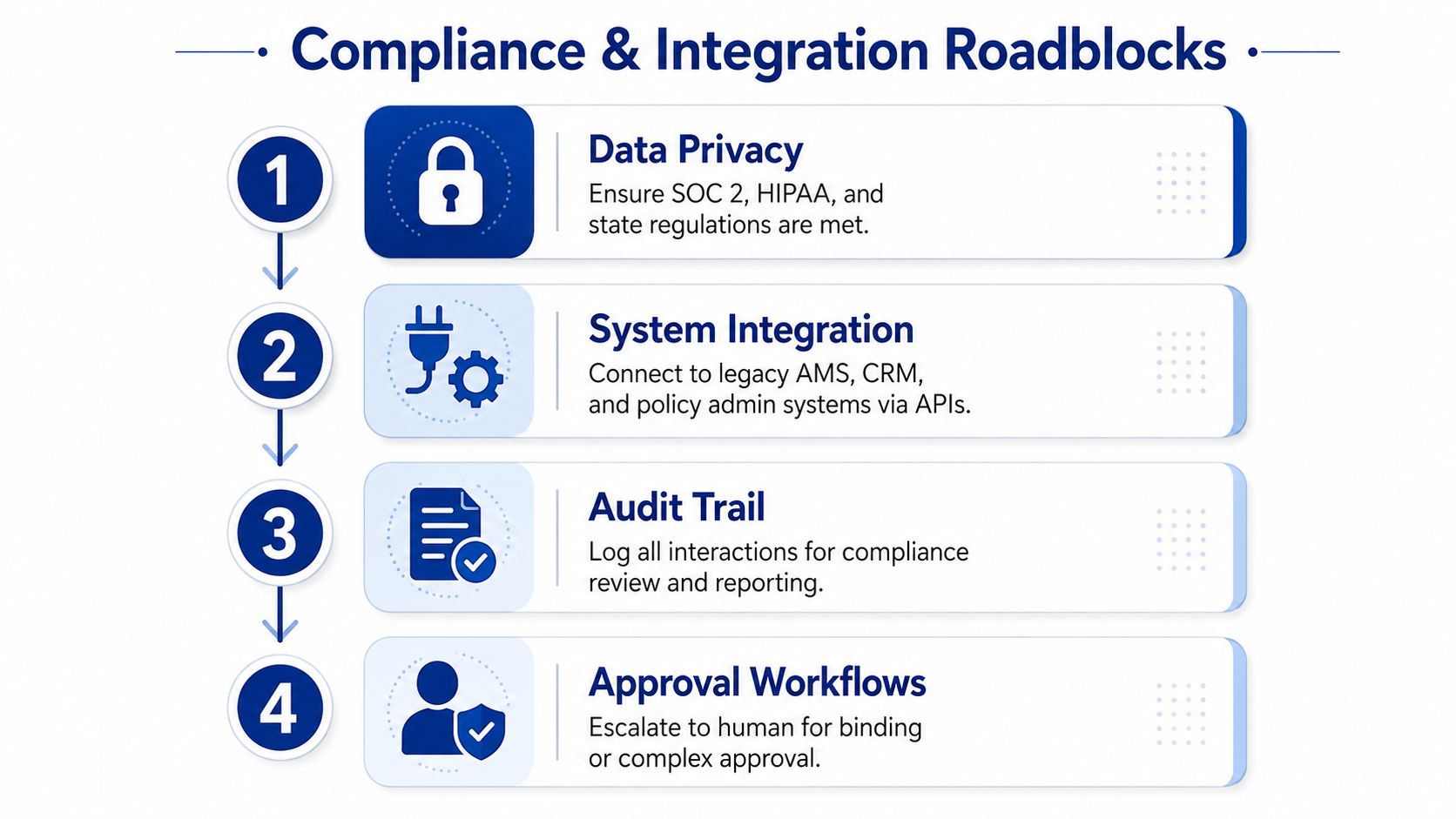
Data access is the first control point. Give the assistant only the information required for its assigned task. Regulated or sensitive records also need rules for exposure, retention, and logging. Those controls become harder across departments because service, claims, and sales may use different permission models.
System fit creates a separate source of rework. Agencies often rely on legacy management platforms and connected tools that were not designed for API-first automation. If quoting, policy administration, CRM, and document storage lack a dependable handoff layer, the assistant may collect information successfully while staff still re-enter it elsewhere.
That result shifts labor instead of removing it.
Why the audit trail matters
Every interaction should be reviewable. The system must record what the assistant accessed, what it collected, what it changed, and where it escalated the case. Without those records, compliance staff have to reconstruct events after a problem appears, making missing evidence difficult to correct.
If the assistant cannot explain its handoff, it is not ready for broader production use.
Approval workflows define the boundary between preparation and licensed judgment. Requests involving binding, exceptions, or complex coverage decisions should reach a qualified human before leaving the system. The assistant can assemble documents, identify missing fields, and recommend a queue. It should not make the final decision where professional judgment carries regulatory or financial exposure.
A practical rollout sequence keeps the risk visible. Connect the core data sources, define escalation rules, test logging and permissions, then expand the assistant's scope. Teams that reverse this order often spend more time correcting edge cases than they saved through initial automation. The guidance on outsourcing business processes also supports sequencing operational work around clear ownership, controls, and handoffs.
Measuring ROI Beyond Labor Substitution
The most revealing benchmark is that 42% of organizations using virtual assistants could not explain what value they were receiving. That finding from Datos Insights points to a measurement gap inside implementation programs. Teams often track labor savings while overlooking service speed, backlog reduction, data quality, and handoff performance.
Start with the workflow, then define the measurement points. Track claims intake time, renewal follow-up completion, missing information, rework, escalation rates, and the time a case waits between systems. If an assistant opens the conversation and a licensed employee completes it, assign ownership at each stage before launch. Otherwise, reported savings may reflect delayed work rather than reduced work.
Vendor promises versus trackable results
| ROI Metrics: Vendor Promises vs. Trackable Reality | Metric Category | Vendor Promise | Trackable Reality | Instrumentation Gap |
|---|---|---|---|
| Service speed | Faster response and lower handling time | Measurable queue reduction if timestamps are logged | Many AMS setups don't capture every handoff cleanly |
| Claims processing | Lower processing cost | Shorter intake and fewer missing fields | Needs workflow-level tracking, not just volume counts |
| Revenue support | More cross-sell and retention | Better follow-up and cleaner renewal routing | Attribution is hard when multiple people touch the account |
| Compliance quality | Fewer errors and more consistency | Better scripting and fewer missed steps | Requires audit logging and review sampling |
The comparison with adding staff should include more than hourly cost. The discussion in GRIT's remote support comparison highlights the operational question: can the work be standardized, documented, and delegated with appropriate oversight? That question determines whether an insurance assistant produces measurable value.
Legacy AMS and claims platforms can obscure results because timestamps, ownership changes, and exception handling are recorded inconsistently. Establish a baseline before configuration, review outcomes by workflow rather than total transaction volume, and separate automated completion from human-assisted completion. ROI becomes credible when managers can connect each improvement to a defined process and verify the cases that still required judgment.
Real Deployment Scenarios for Agencies
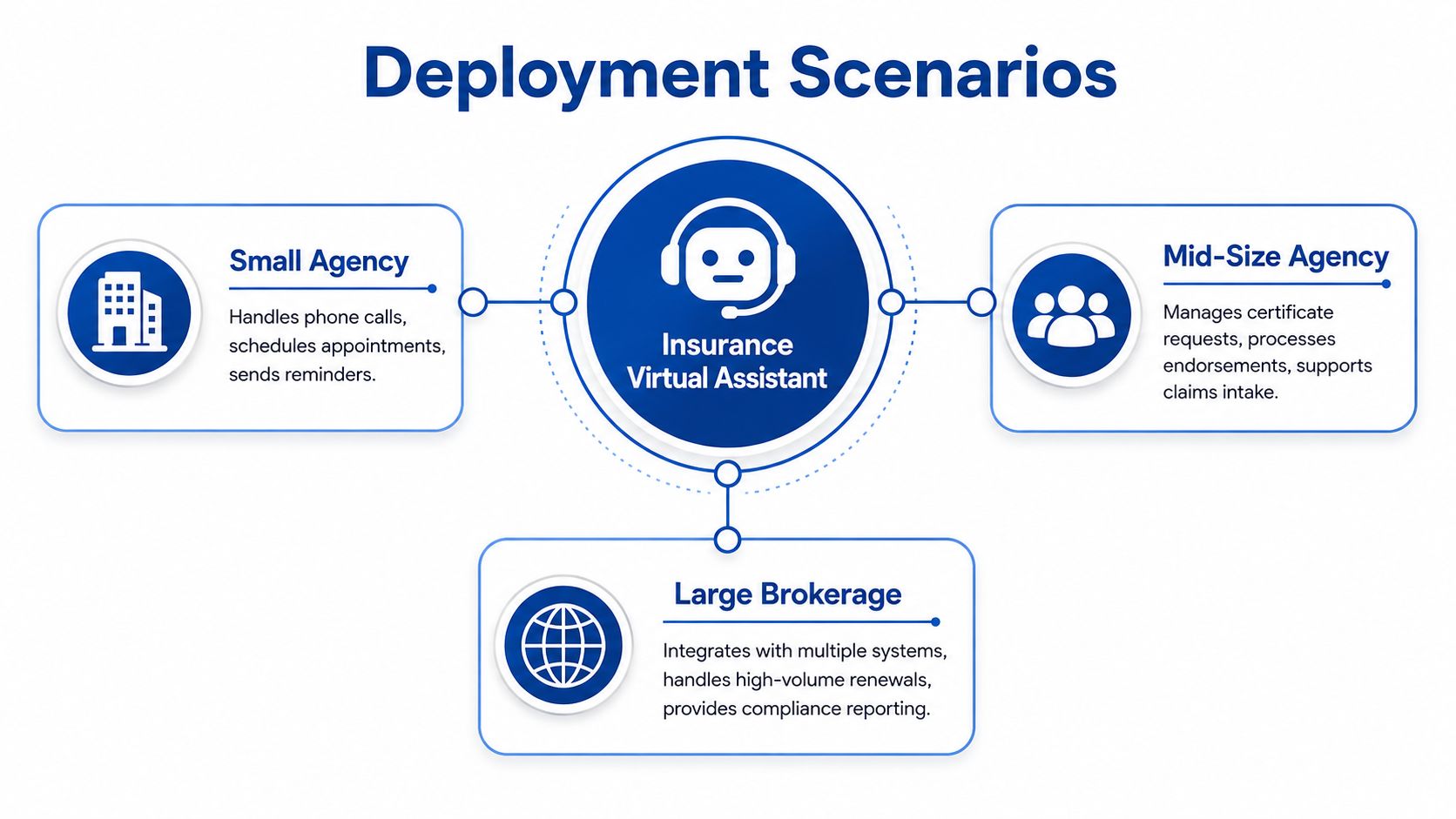
Insurance agencies rarely begin with a full platform rollout. They start with one workflow that creates avoidable pressure, then expand after the assistant proves it can work inside existing systems without weakening review controls.
A mid-market P&C agency
A commercial lines agency may begin with renewal preparation. The assistant can pre-populate applications, identify missing exposure information, and assemble the file before a producer reviews it. The producer still takes over for negotiation, unusual risk analysis, and coverage recommendations that require judgment.
The first implementation test is system access. If the assistant cannot reliably read the agency's existing record system, preparation work remains manual. Adoption also improves when the tool removes file assembly and follow-up from the producer's day instead of presenting itself as a replacement for professional judgment.
A high-volume personal lines agency
Personal lines operations often apply the assistant to claims intake and service routing. It can sort first notice of loss submissions, apply severity tags, and send catastrophic or sensitive matters to senior adjusters. Simpler glass claims or low-complexity requests may follow a shorter path, provided the rules and escalation points are documented.
The staffing decision still requires operational design. GRIT's staffing model reflects the need to combine automation with human coverage during peak periods. Poor routing does not remove the queue. It produces a more orderly backlog and can make unresolved exceptions harder to notice.
A benefits agency during open enrollment
Benefits agencies face concentrated demand during open enrollment. An assistant can answer repetitive plan questions, issue reminders, and keep routine enrollment support moving within approved language. Questions involving ERISA-sensitive interpretation should go to a human when the response could influence a member's decision or create legal exposure.
The early operating period is for correction, not optimization. Teams need to review failed handoffs, unclear answers, and records that require manual intervention before judging the deployment.
Document controls also matter. Closer Innovation Labs Corp. eSignatures is an adjacent reference for teams adding an approval layer around documents. The assistant must know who may sign, who may approve, and which documents require additional review. Those controls determine whether the workflow can move safely across legacy systems and compliance checkpoints.
Building Your Virtual Assistant Strategy
Start with a workflow, not a platform. Before configuration begins, confirm that policy data is usable, escalation paths are documented, and the compliance owner has approved what the assistant may say on the record. Without those controls, the result is a demonstration rather than an operating process.
Choose a narrow first use case. First notice of loss intake or certificate requests often work because their steps repeat, exceptions can be defined, and human review points are visible. After the handoff performs reliably, extend the design to endorsements, renewals, or broader service routing.
Pilot one workflow, prove the handoff, then scale the exception handling.
Build versus buy depends on operational complexity. Smaller teams may suit a SaaS product with prepared insurance workflow logic. Larger MGAs and carriers may justify custom orchestration when approvals, data flow, or integration across legacy systems require tighter control. Teams assessing business process outsourcing options should also decide which tasks remain with licensed staff and which can move to remote support. GRIT Virtual Assistants LLC is one provider that combines remote staffing with AI workflow implementation.
Plan for a measured rollout rather than instant results. A constrained workflow can require a 60 to 90 day pilot, followed by longer integration work across agency systems. Treat the first quarter as calibration time. Track handoff failures, manual interventions, response quality, and staff time recovered before making a cost claim. The useful signal is whether the assistant removes friction and lets licensed staff focus on decisions that require judgment.
Document approval controls early. Closer Innovation Labs Corp. eSignatures offers an adjacent reference for teams adding document approvals. Define who may sign, who may approve, and which records require review before the workflow crosses a compliance checkpoint.