
You already know the work is piling up, but the exact hire still isn't clear. One week it looks like you need an executive assistant, the next it feels like customer experience coverage, then operations ownership, then maybe a managed team that can keep moving without constant supervision. That's the point where a remote staffing company conversation needs to stop sounding vague and start sounding operational.
Ask the right questions and the answer gets sharper fast. You'll uncover business impact, role boundaries, AI and human responsibilities, security practices, management support, pricing structure, and scalability. A provider like GRIT Virtual Assistants LLC is built around that kind of conversation, with AI-enhanced remote staffing, structured onboarding, SOP support, and flexible engagement models.
The goal isn't to find the cheapest provider, it's to find the clearest path to reliable capacity.
Use the seven questions below in discovery calls, vendor comparisons, and planning sessions. They're organized around real decision moments, from workload pressure to long-term engagement design.
Table of Contents
- 1. GRIT Virtual Assistants LLC
- 2. BELAY
- 3. Boldly
- 4. Prialto
- 5. Time etc
- 6. Wing Assistant
- 7. SupportNinja
- Top 7 Remote Staffing Companies Comparison
- Choose the Provider That Fits the Work
1. GRIT Virtual Assistants LLC
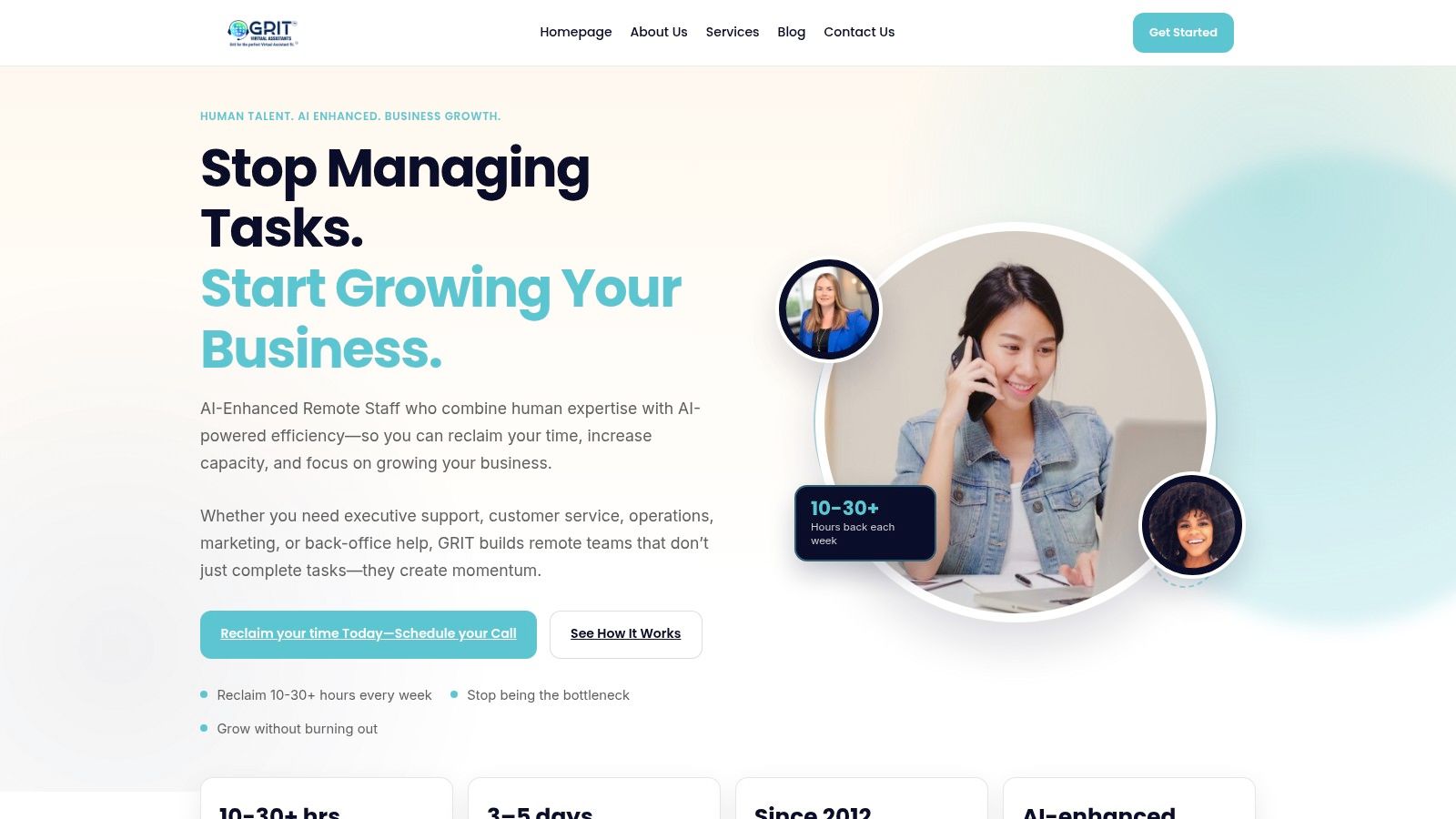
Use GRIT Virtual Assistants LLC when the issue is not just “we need admin help,” but “we need someone who can own real work.” GRIT recruits, vets, onboards, and coaches AI-enhanced remote professionals across executive support, customer experience, sales and marketing ops, accounting, legal and paralegal support, project coordination, operations, and AI workflow implementation. That makes it a fit for leaders who want human judgment, plus AI-assisted drafting, research, triage, and automation, not a task-only temp.
What the right answer reveals
Start with outcome, not headcount. If a provider talks only about “finding talent,” push harder. A strong answer connects the role to a measurable business result, such as freeing leadership time, stabilizing follow-up, standardizing handoffs, or building repeatable systems.
GRIT's model stands out because it combines placement with operating support. It includes personality and skills assessments, AI-enabled workflows, SOP development, productivity monitoring, performance reviews, and secure remote work practices. That matters if you want a hire to take on real responsibility quickly instead of spending weeks waiting for the team to explain everything twice.
What strong delivery sounds like
Listen for ownership of execution, not just sourcing. The strongest providers explain structured onboarding, clear expectations, and ongoing coaching that lets the assistant improve over time. If you want examples of how that kind of positioning shows up in practice, SupportGPT virtual assistant examples is a useful reference point.
GRIT also offers flexible hourly, monthly retainer, and project-based engagement models. That gives you room to match the support structure to the workload instead of forcing the workload into a rigid plan.
Ask for the workflow, not just the resume. If the provider cannot explain how work gets handed off, tracked, and improved, the placement will stay fragile.
What deserves follow-up
Pricing is not listed publicly, so you will need a discovery call to define scope. That is fine if you want specific support, but it means you should bring a written task inventory and expected coverage before you talk money. For buyers comparing options, GRIT's remote staffing page is the best place to start, and WorkSignal's staffing agency solution helps as a broader comparison point.
2. BELAY
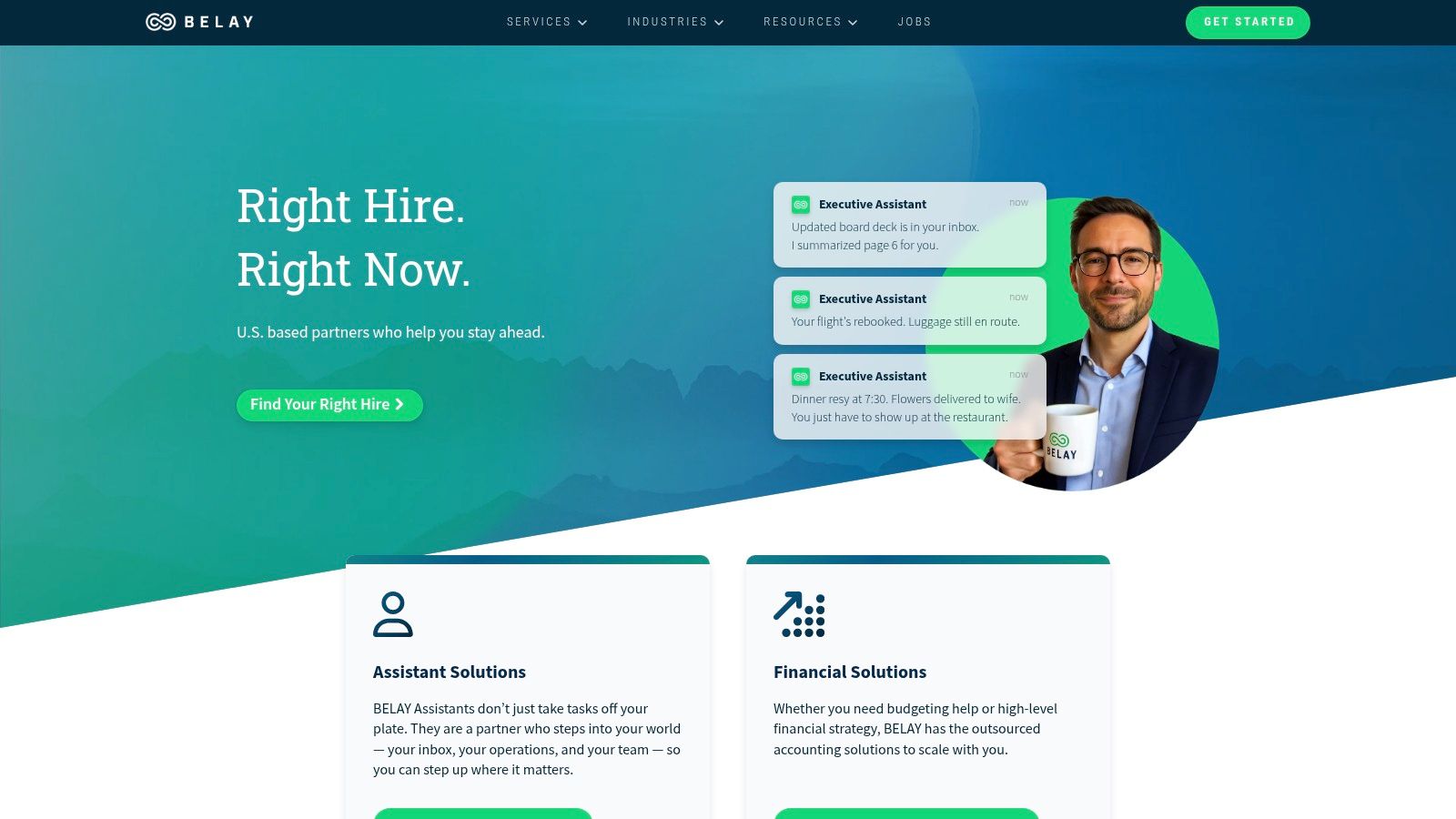
BELAY makes sense when you want U.S.-based coverage and a managed relationship instead of a loose freelancer arrangement. It pairs dedicated virtual assistants with bookkeeping, accounting, payroll, tax, and social media support, so the conversation can expand beyond admin if the workload starts crossing functions. For many SMB leaders, that continuity is the value, not just task completion.
What to ask about role continuity
Ask whether the assistant is matched to your business requirements and backed by a client success team. A strong answer should explain how the provider handles onboarding, process alignment, and secure work practices without forcing your team to repeat the same instructions every week. That's especially important if the role touches finance, scheduling, or leadership communication.
BELAY's strength is range. If a business starts with a virtual assistant and later needs bookkeeping or accounting continuity, the relationship can grow without rebuilding the vendor list from scratch. That makes the provider useful for leaders who want a stable operating partner rather than a narrow administrative contractor.
What deserves follow-up
The key trade-off is price structure. BELAY doesn't publish a rate card, so the quote will be custom and scope-based. That usually signals a premium model, which is fine if you value U.S. alignment and a managed service, but it's the wrong fit if you only need lightweight task coverage.
Use BELAY when consistency matters more than bargain pricing. If the work touches confidential information, U.S. time-zone overlap and structured onboarding should be part of the selection criteria.
Ask specifically what happens if the role changes midstream. If the provider can add bookkeeping or payroll support without restarting the search, that's a sign the model is built for continuity. If not, you're probably buying a narrow placement, not a durable staffing solution.
3. Boldly
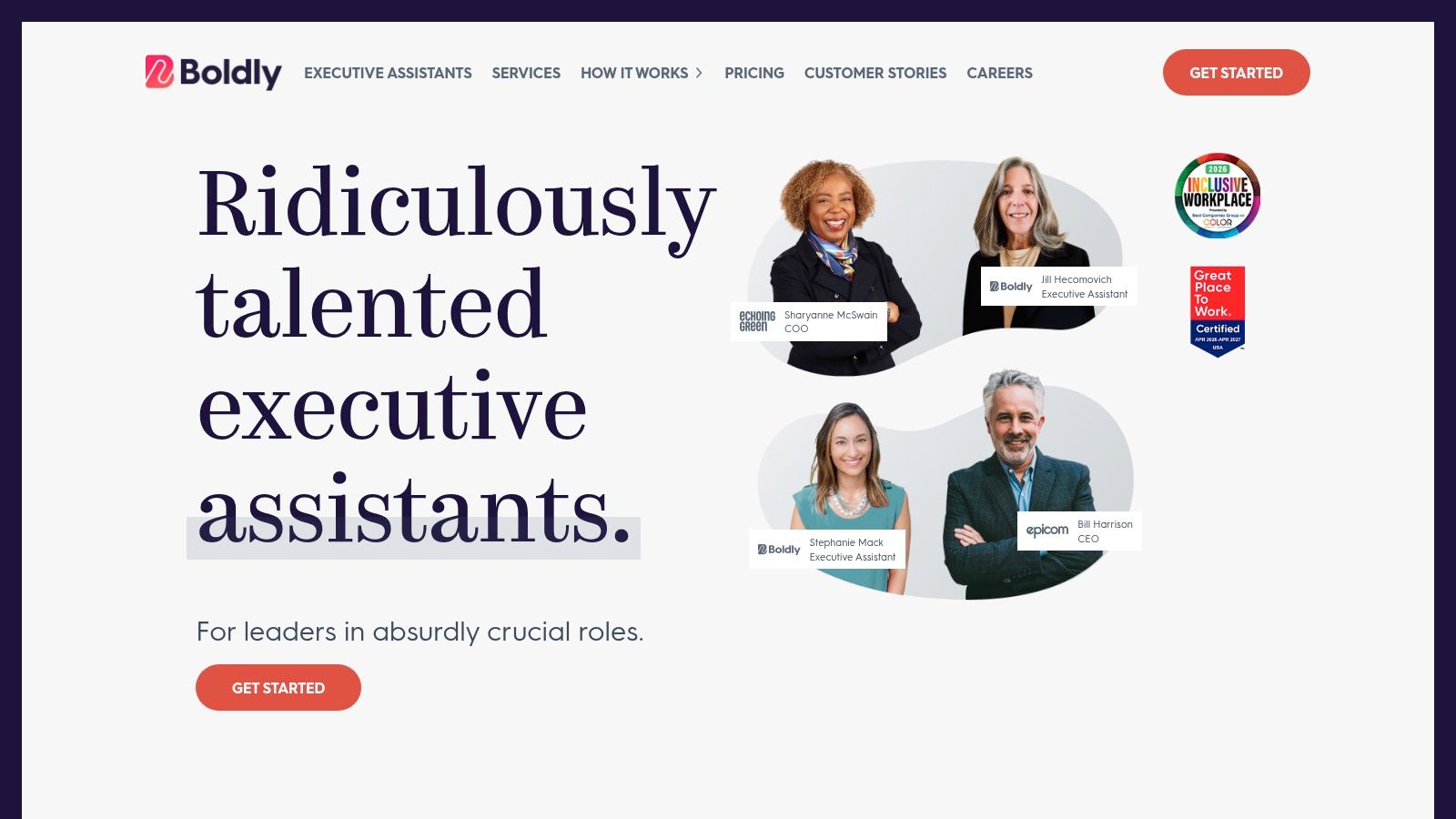
Boldly is for buyers who want senior-level support and don't want to manage a revolving door. It uses a subscription model with monthly hour tiers and employs vetted W-2 professionals, which helps with stability, retention, and continuity across executive assistant, marketing, and project coordination work. The setup fits teams that value reliability and a close working rhythm.
The question that separates premium from generic support
Ask how the provider preserves continuity when the assistant is already embedded in your systems. A strong answer should cover vetting, HR management, time tracking, confidentiality standards, and how a client dashboard keeps the relationship visible. Those details matter because senior support only works if the person can stay inside your operating cadence without constant re-explaining.
Boldly's model is built for leaders who want a dedicated person, not a pool of rotating help. That matters when the assistant is handling calendar control, communications, or project follow-through. If the vendor can explain how they maintain tenure and consistency, you're probably talking to the right kind of provider.
Where the trade-off shows up
The downside is clear. This is a premium subscription model, pricing isn't public, and the service is oriented to business hours rather than follow-the-sun coverage. That's fine if your work lives in weekday executive support, but it's a mismatch if you need around-the-clock operations or a large CX team.
If your pain is turnover, ask about employment structure first. A good staffing answer starts with retention, not just matching.
Boldly is a strong choice when the person in the role needs to become part of the leadership machine. It's less attractive when the need is variable, highly transactional, or overnight. Use it when continuity is the buying trigger.
4. Prialto
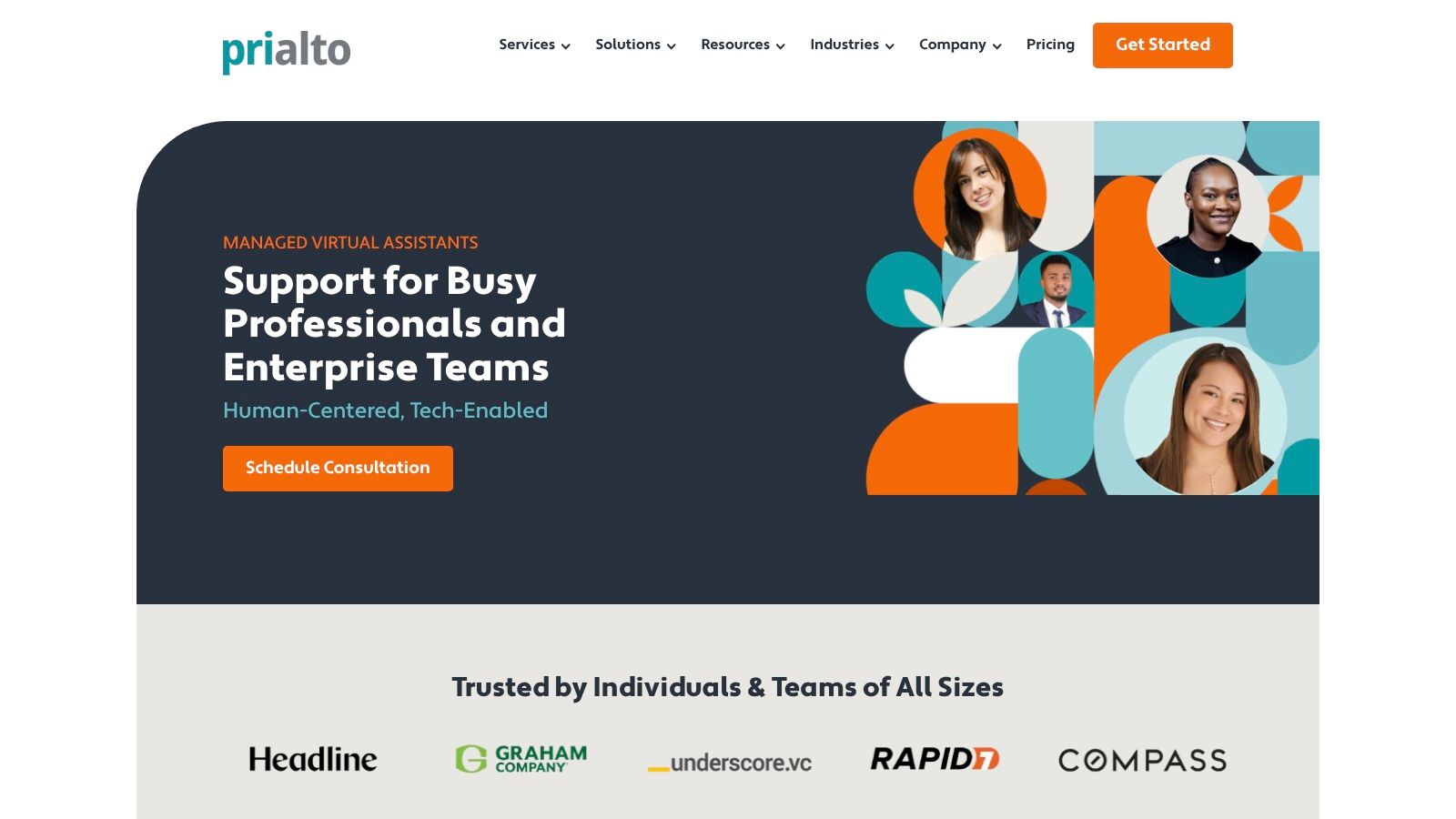
Prialto is a good test case for buyers who want the support model to include management, not just labor. It sells support in monthly Units, with a dedicated assistant, backup coverage, engagement management, workflow documentation, and continuity features that reduce client-side coordination work. That structure is attractive when the business wants the benefit of delegation without adding more internal admin overhead.
What the pricing model tells you
Ask what a Unit includes and how overflow works. A strong answer should be specific about the assistant relationship, the backup layer, and what management support stays with the provider. That reveals whether you're buying a staffing block or a managed operating layer.
Prialto's transparent published pricing is a meaningful advantage. It gives buyers a cleaner way to compare scope and unit economics than a quote-only model does. The business can also scale the arrangement more predictably if the workload grows or if a second Unit becomes necessary.
What to challenge in the discussion
The trade-off is that the model is built around weekday business hours and can get expensive if you need a full-time dedicated role. If your workload is steady but not huge, the Unit model can be efficient. If the work is broad, urgent, or full-time, you need to compare the cost against a direct hire or a more customized staffing setup.
Ask who owns the SOPs, the follow-up, and the correction cycle. If the provider manages those pieces well, your team spends less time supervising the assistant and more time using the output.
Prialto is especially useful for professional services teams that value continuity and process. It's not the broadest or fastest option, but it's disciplined, easy to compare, and better than a loose pool of freelancers when the work must stay organized.
5. Time etc
Time etc works well when the workload is recurring, measurable, and easy to break into hours. The service offers tiered monthly plans with U.S.-based assistants, rollover hours, the ability to add or share assistants, and a satisfaction guarantee. That makes it a practical fit for entrepreneurs and SMB teams that need ongoing admin, research, scheduling, and light operations support.
What the hours question exposes
Ask how the provider handles plan changes when workload spikes or dips. A strong answer should explain the tier structure, unused hour rollover, and whether multiple team members can share capacity under one plan. That tells you whether the vendor is built for flexible support or just fixed-time billing.
This model is strongest when the work is steady and defined. If your team needs scheduling, inbox support, research, and follow-up every week, the hour-bank structure can feel simple and predictable. If the need is more like a full-time role with complex ownership, the model starts to strain.
Where to push for clarity
The main trade-off is that Time etc is not a fully managed CX or BPO solution. It's not designed for 24/7 support or large-team operations. That's not a flaw, it just means you should use it for ongoing recurring tasks rather than a broad service desk.
For leaders comparing time-based support, the internal question is whether the work is hourly or functionally operational. If the provider can show that the assistant can absorb recurring work without constant rescoping, the model fits. If not, you're better off with a managed staffing company that includes more oversight.
For a practical example of what getting time back looks like in real work patterns, GRIT's time-back walkthrough is a useful contrast point.
6. Wing Assistant
Wing Assistant is a strong fit when predictable daily coverage and managed replacement support matter. It offers dedicated assistants across general admin, customer service, sales, marketing, and HIPAA-compliant healthcare work, with customer success manager oversight, QA, replacements, and a companion app for collaboration. That's useful for SMBs that want structure instead of improvising process on the fly.
What makes the operational question different
Ask how the provider prevents disruption when a replacement is needed. A strong answer should cover QA, escalation, the role of the customer success manager, and how tasks are transferred into the companion app or workspace. If the provider can explain the continuity process clearly, the business can keep moving even when staffing changes.
Wing's healthcare path is especially relevant for practices that need HIPAA-aligned workflows. The presence of published healthcare VA pricing helps create a more predictable buying process there than in many custom-quote models. For non-healthcare roles, pricing may vary by experience and function, so the buyer has to scope carefully.
What trade-off to watch
Wing can work very well if the workflow is well defined. The more ambiguous the task list, the more matching quality matters. If the scope is fuzzy, the provider may still place a solid assistant, but results will depend on how clearly you define systems, response times, and deliverables.
If you need managed coverage, ask what happens after onboarding week one. That answer tells you whether the provider is really supporting the role or just staffing it.
Wing is best when the buyer wants an assistant who can stay in rhythm with daily tasks and when managed replacement support is part of the value. It's less compelling if the ask is a few loose tasks a week with no process.
7. SupportNinja
SupportNinja belongs in the conversation when the staffing need is expanding into customer operations or a managed team. It builds tech-enabled customer support, onboarding, technical support, data operations, and back-office teams across the U.S., Philippines, and EMEA, with options for client-managed sourcing or fully managed operations. That makes it much more than a single-assistant provider.
The question that reveals scale readiness
Ask whether the provider can support one role now and a team later without changing the operating model. A strong answer should mention QA, reporting, scheduling, multilingual capability, and how data operations or AI data enablement fits the delivery structure. If those pieces are in place, the vendor can grow with the business instead of forcing a switch later.
SupportNinja's flexibility is the point. A company can start with client-led candidate selection, then move into fully managed sourcing and training when workload increases. That makes it a serious option for ecommerce and SaaS teams that expect the support function to become more complex over time.
Where the buyer should be strict
The downside is scope. If you only need a few hours of general admin support, this is probably too much service. Pricing is custom, and the breadth of the catalog means you need to define exactly what gets handled, where the handoffs live, and who owns QA.
For leaders comparing a simple assistant to a managed support unit, this is the right question, do you need capacity or coverage. If the answer is coverage, SupportNinja can be the better fit. If the answer is capacity for one leader, a lighter provider will usually be easier to buy and deploy.
For a direct comparison of AI-enhanced remote support versus a local hire, GRIT's remote support comparison is a useful reference point when you want to weigh operating model, not just headcount.
Top 7 Remote Staffing Companies Comparison
| Provider | Implementation complexity | Resource requirements | Expected outcomes | Ideal use cases | Key advantages |
|---|---|---|---|---|---|
| GRIT Virtual Assistants LLC | Low–Moderate, structured onboarding + AI workflow setup | AI‑enhanced vetted remote assistants; flexible hourly/retainer/project engagements | Reclaim 10–30+ hrs/week; SOPs, productivity monitoring; up to ~70% cost savings vs local hire | SMB leaders needing executive support, ops, and AI workflow implementation | Human-first AI enhancement, fast matching (3–5 days), ongoing coaching & SOP development |
| BELAY | Moderate, managed relationship with structured onboarding | U.S.-based assistants + internal success team; broader finance stack | Reliable U.S. timezone coverage and continuity across admin/financial services | Leaders wanting U.S. time-zone alignment and bundled bookkeeping/accounting support | U.S. culture fit, bundled financial services, client success support |
| Boldly | Low, subscription onboarding into monthly hour tiers | Senior W‑2 professionals on subscription; premium budget | Senior, long-tenured support with minimal ramp-up and continuity | Buyers who want senior part‑time talent without hiring in-house | Vetted senior talent, W‑2 employment for retention, reliable coverage |
| Prialto | Low–Moderate, Unit model with engagement management | Monthly Units (~55 hrs) including backup assistant and Engagement Manager | Predictable capacity with documented SOPs and managed continuity | Executives/SMBs wanting scalable, managed admin support with transparent pricing | Transparent Unit pricing, backup coverage, Engagement Manager oversight |
| Time etc | Low, straightforward hour‑bank plan setup | Tiered monthly hour plans (10–60 hrs), U.S.-based assistants, rollover hours | Predictable, flexible support for recurring admin tasks | Entrepreneurs and small teams needing ongoing executive/admin help | Clear published rates, flexible plans, satisfaction guarantee |
| Wing Assistant | Moderate, managed model plus compliance setup for healthcare | Dedicated assistants, customer success manager, companion app; HIPAA option | Predictable daily coverage and HIPAA‑aligned workflows where needed | SMBs requiring healthcare/HIPAA assistants or predictable daily support | HIPAA compliance, broad role catalog, managed replacements & QA |
| SupportNinja | High, full CX/BPO setup with QA, scheduling, reporting | Multi-site delivery (U.S./Philippines/EMEA), QA teams, managed operations; larger budget | Scalable multichannel CX and back‑office operations, 24/7 capability, reporting | SMBs/ecommerce/SaaS needing to scale to managed teams or 24/7 support | Scales from single assistants to managed teams, broad service catalog, multilingual support |
Choose the Provider That Fits the Work
Use the seven questions in order. First, define the workload and the outcome you need. Then compare the delivery model, because a dedicated assistant, a subscription hour bank, and a managed team solve different problems. After that, verify the safeguards, the management support, and the continuity plan before you look at pricing and scalability in writing.
Score each provider against role fit, coverage, onboarding, continuity, security, reporting, and engagement flexibility. Don't rely on brand recognition alone. A strong brand can still be the wrong operating model if the workflow is messy, the coverage window is off, or the handoff process depends on constant client supervision.
If your need includes AI-enhanced human support, SOP development, coaching, and flexible staffing, GRIT Virtual Assistants LLC deserves a focused discovery call. If your need is more narrow, use the same questions to pressure-test a different provider until the answers become concrete instead of promotional.
Bring a written task inventory, expected hours or coverage, required systems, success measures, and handoff risks to the next vendor conversation. That's how you turn a broad staffing discussion into a real operating decision.
GRIT Virtual Assistants LLC helps leaders turn overloaded workflows into reliable capacity with AI-enhanced remote staffing, structured onboarding, and ongoing coaching. If you're comparing providers for executive support, customer experience, operations, or scalable team support, visit GRIT Virtual Assistants LLC to see how its model fits the work you need done now.