
A clinical initiative can look healthy on paper while losing control. The kickoff meeting happened, the physician champion agreed, and the spreadsheet contains a target date. Then schedules conflict, an approval sits in someone's inbox, a data field is interpreted two different ways, and nobody can say who owns the next decision. By the time leadership asks for an update, the project coordinator healthcare function has become an emergency recovery exercise instead of a predictable operating system.
That pattern is common because the title often sounds administrative while the work sits close to clinical operations, funding requirements, privacy obligations, and regulated documentation. The right coordinator doesn't provide mere clerical support. They create visible ownership, maintain execution discipline, and know when a task must move to a clinician, privacy lead, compliance officer, or licensed professional.
Table of Contents
- The Hidden Cost of Coordination Gaps in Healthcare Projects
- What a Healthcare Project Coordinator Does
- Core Skills Every Healthcare Project Coordinator Needs
- Remote Staffing vs In-House Hiring for Healthcare Coordination
- How to Hire the Right Healthcare Project Coordinator
- Compliance Risks and Remote Work Boundaries
The Hidden Cost of Coordination Gaps in Healthcare Projects
A new referral workflow can stall without a visible crisis. Clinicians expect shorter delays, operations prepares training, and a funder requires progress reports. Then one department changes its intake form, another keeps using the old version, and the reporting owner finds that required data was never collected consistently.
The problem is not only missed administration. In healthcare, an administrative title can conceal work adjacent to clinical decisions, privacy controls, funding conditions, and regulated documentation. A coordinator may maintain the workflow, reconcile records, and prepare reports, but clinical interpretation, patient-care decisions, and licensed sign-off must remain with the appropriate professional.

A capable coordinator serves as the control point for execution quality. They maintain the work plan, clarify dependencies, record decisions, follow up on unresolved actions, and escalate risks before a missed milestone surprises leadership. The documented role scope links the position to indicators, targets, budgets, variance reporting, change-management methods, stakeholder coordination, documentation, data collection, and outcome reporting. The documented role scope shows that the job extends well beyond meeting logistics.
Practical rule: If nobody owns the master plan and action register, the project lacks operational control.
Capability is another hidden cost. A 2024 peer-reviewed study found that 86.3% of surveyed healthcare professionals lacked formal project-management certification, while 56.9% had direct project-management or coordination experience. The study details illustrate why availability alone is a poor staffing criterion. Experience coordinating work does not automatically establish authority to make clinical or compliance decisions.
Without clear boundaries, clinical leaders reconstruct status, analysts repair incomplete data, and administrators approve changes without seeing dependencies. Organizations considering outsourcing business processes should define which coordination tasks can be handled remotely and which require on-site access, clinical review, or licensed supervision. That distinction protects delivery, reporting accuracy, and patient-facing operations.
What a Healthcare Project Coordinator Does
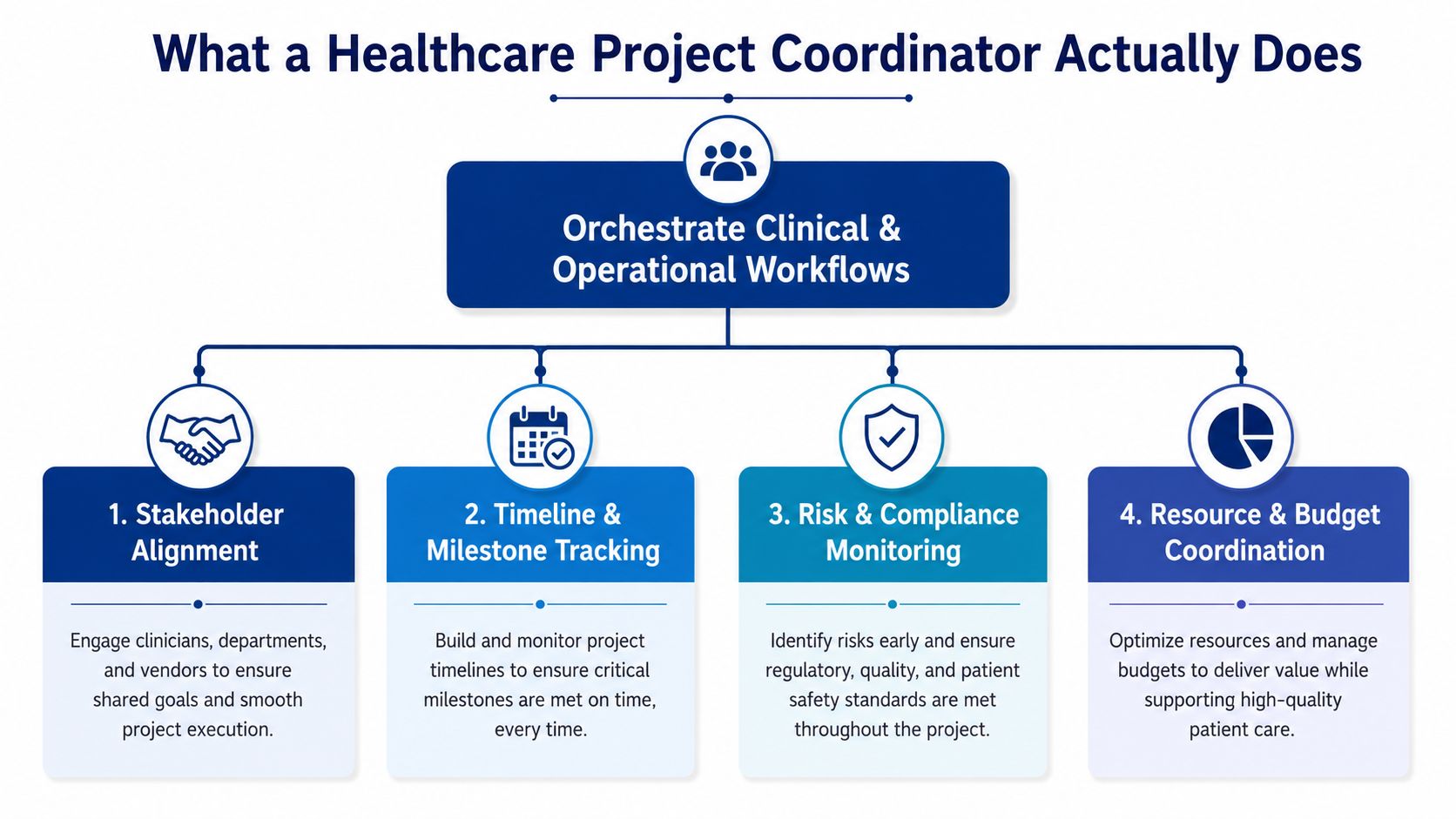
A coordinator turns an approved healthcare initiative into controlled daily work. The title sounds administrative, but the job often sits close to clinical workflows, patient information, and compliance decisions. Four connected responsibilities define the role, and each has a different failure mode.
Scope and planning
The coordinator converts an idea into an operating plan. It should state the intended outcome, deliverables, indicators, targets, dependencies, owners, assumptions, and approval points. For a clinical access initiative, that may connect physician availability, referral intake, patient communication, training, data capture, and reporting requirements.
A task list is not enough. A usable plan specifies what must happen, who owns it, what evidence confirms completion, and what happens when a dependency slips. That level of definition also shows which work can be coordinated remotely and which requires access, clinical review, or supervision.
Execution control
Daily coordination includes maintaining the timeline, monitoring milestones, preparing agendas, recording decisions, updating action items, and following up with people whose clinical and administrative priorities compete.
The coordinator also tracks budget activity and variance. If an invoice, staffing assumption, or implementation expense differs from the approved plan, the coordinator documents the variance and its cause, then routes the decision to the authorized owner. They should not approve a clinical, financial, or compliance change solely because it appears in a tracker.
Stakeholder alignment
Healthcare projects cross professional boundaries. Physicians, nurses, administrators, health authorities, funders, vendors, analysts, and patients may each see only part of the work. The coordinator creates a shared operating view while preserving differences in authority.
A practical communication rhythm separates routine updates from governance decisions. Status notes should identify completed work, upcoming commitments, blocked items, risks, and decisions required. A material issue should not disappear inside a long meeting summary.
Reporting and evidence
The coordinator gathers evidence leaders and funders use to assess progress. This may include milestone status, activity records, data-quality checks, budget variance, risks, and outcome indicators. The coordinator can prepare the report, but clinical interpretation, patient-safety judgments, and approvals outside the role's authority belong to qualified leaders.
The role therefore extends well beyond scheduling. The healthcare coordination description links work plans, budget controls, stakeholder follow-up, and reporting quality with keeping health-program activities aligned and limiting project drift. Clear boundaries determine whether those responsibilities remain safe administrative coordination or cross into work requiring licensed supervision.
Core Skills Every Healthcare Project Coordinator Needs
Hiring for “excellent organization” isn't enough. A strong candidate must show how they create control when several teams use different systems, priorities, and definitions of completion.
Operational discipline
Look first for evidence of execution habits. The coordinator should be able to build a dependency-aware work plan, maintain a decision log, distinguish an action from an unresolved discussion, and escalate a blocked task with enough context for a leader to act.
Ask candidates to describe how they would manage a project where physician schedules, vendor delivery, staff training, and reporting deadlines collide. A useful answer should include ownership, dates, dependencies, escalation routes, and a method for recording decisions. Generic statements about “communicating more” aren't evidence.
They should also be comfortable with practical tools such as Microsoft Excel or Google Sheets for trackers, Microsoft Teams or Slack for controlled communication, and a project platform such as Asana, Smartsheet, or Microsoft Planner when the organization has approved its use. The tool matters less than whether the coordinator maintains one trusted source of status.
Clinical-adjacent literacy
The coordinator doesn't need to practice medicine to work effectively around clinical teams. They do need to understand the difference between a workflow step, a clinical judgment, a data definition, and a patient-safety concern.
That literacy helps them ask better questions. If a metric changes, they should clarify whether the change reflects a real operational result, a documentation change, or a data-quality problem. If a clinician disputes a process, the coordinator should capture the issue and route it appropriately, not resolve it by guessing.
Compliance awareness
Compliance skill means recognizing boundaries early. Candidates should understand least-necessary access, secure document handling, version control, retention expectations, approval records, and escalation for privacy or safety concerns. They should know that a clean spreadsheet can still represent a governance problem if its source, access, or purpose isn't controlled.
Use a short scenario during interviews. Give the candidate a request for patient-adjacent information and ask what they would access, what they would avoid, who they would consult, and how they would document the decision. This reveals judgment more effectively than asking whether they are “detail-oriented.” Teams also benefit from a disciplined approach to focus and prioritization, such as the practices described in this guide to avoiding workplace distraction.
Remote Staffing vs In-House Hiring for Healthcare Coordination
The choice between an employee and a remote coordinator isn't a simple question of office presence. It depends on the work's sensitivity, required supervision, operating hours, systems access, and how much management capacity the organization can provide.
An in-house hire offers proximity to clinical leaders and informal context. That can help when the coordinator must attend frequent onsite meetings, observe physical workflows, or manage relationships that depend on immediate presence. The trade-off is a heavier employment structure and the need to recruit, onboard, supervise, and retain a professional whose work may fluctuate with project demand.
A remote model can work well for plan maintenance, meeting preparation, action tracking, documentation, report assembly, scheduling, and approved administrative workflows. It becomes less suitable when the role requires unsupervised clinical interpretation, direct handling of sensitive records without an approved environment, or immediate physical intervention.
Compensation benchmarks also show why leaders should classify the role correctly. One 2025 labor-market summary listed a median annual salary of $55,125 and a top-10% salary of $78,000, while a 2026 U.S. posting listed $74,650.52 to $85,314.88 annually. The compensation listings illustrate that employers often budget this as a professional coordination function, not basic clerical work.
| Metric | Range / Value | Source Year |
|---|---|---|
| Median annual salary | $55,125 | 2025 |
| Top-10% annual salary | $78,000 | 2025 |
| U.S. posting range | $74,650.52 to $85,314.88 | 2026 |
A practical decision test
Choose in-house when physical presence, deep institutional knowledge, or direct clinical integration is central to the role. Choose remote support when the deliverables are structured, access can be controlled, and a designated internal leader can supervise clinical and compliance decisions.
An AI-enhanced remote staffing model can speed drafting, summarization, task organization, and document preparation, but AI doesn't remove accountability. A human must verify outputs, protect confidential information, and decide what requires escalation. Organizations considering a remote staffing company should ask how access, supervision, quality review, and handoffs will work before comparing hourly rates.
How to Hire the Right Healthcare Project Coordinator
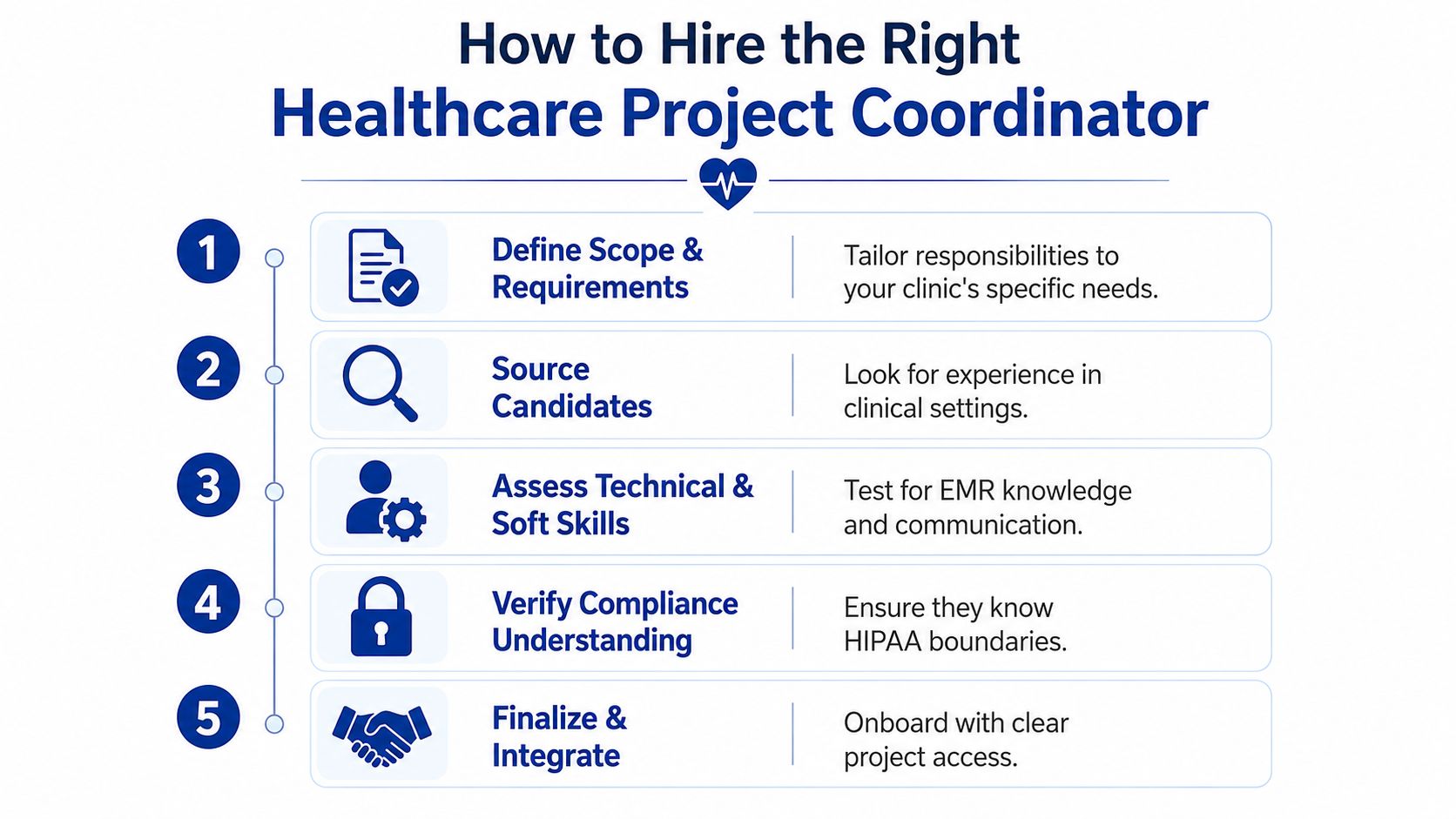
A coordinator hired to manage schedules may end up handling patient-record workflows, study documents, or data-quality issues. That mismatch creates compliance exposure and frustrates the hire. Define the work before choosing the title.
Define the boundary before you recruit
List the projects, systems, stakeholders, decisions, reports, and access requirements. Then divide responsibilities into three groups:
- Own directly: timelines, meeting cadence, action registers, documentation, approved administrative follow-up, and status reporting.
- Coordinate with supervision: patient-record workflows, insurance reconciliation, clinical documentation improvement, data-quality review, and study materials.
- Do not delegate without authority: clinical interpretation, diagnosis, treatment decisions, privacy determinations, and licensed sign-off.
The boundary should appear in the job description, interview scorecard, access plan, and escalation process. A remote coordinator can manage structured administration, while clinical or licensed decisions remain with designated professionals.
Screen for applied judgment
Use scenarios rather than relying on titles or credentials. Ask about a delayed deliverable, a conflicting stakeholder request, or an incomplete data set. Then ask what the candidate documented, who they notified, what they escalated, and how they prevented a repeat.
A strong answer shows judgment at the boundary of administration and clinical oversight. The candidate should know how to organize information without interpreting clinical meaning, change controlled records without approval, or make a privacy decision outside their authority.
The study cited earlier found a gap between formal certification and practical coordination experience. The published study reference supports treating certification as one signal, not a replacement for scenario-based assessment.
Make onboarding operational
Provide a project charter, stakeholder map, approved systems list, escalation matrix, reporting calendar, and examples of acceptable status reports. Assign one accountable internal sponsor. Without that sponsor, the coordinator may collect information but lack authority to resolve ownership conflicts.
Set the first deliverable around visibility: an updated plan, action register, risk log, and reporting rhythm. Those artifacts show whether the coordinator can turn fragmented information into dependable project control.
Compliance Risks and Remote Work Boundaries
The most dangerous assumption is that a coordinator is “only administrative.” Public-facing role descriptions show coordinators working with patient records, insurance reconciliation, clinical documentation improvement, DMC support, confidentiality-sensitive study materials, compliance monitoring, data-quality reviews, and document control. The role patterns described in current postings show how quickly ordinary coordination can touch regulated processes.
Remote work doesn't create the risk by itself. Unclear authority and uncontrolled access do. A remote coordinator can often own project administration safely when the organization provides approved systems, defined permissions, secure communication practices, documented procedures, and an internal clinical or compliance escalation path.
Tasks a coordinator can usually own
A coordinator can generally manage nonclinical execution activities such as:
- Timeline administration: Maintain milestones, dependencies, owners, and status changes.
- Meeting control: Prepare agendas, capture decisions, and track action items.
- Document coordination: Manage approved templates, version history, submission calendars, and controlled folders.
- Operational reporting: Assemble validated inputs and flag gaps without interpreting clinical meaning.
- Scheduling and follow-up: Coordinate approved appointments, training, stakeholder meetings, and reminders.
These activities still require organizational policy. “Administrative” doesn't mean unrestricted.
Tasks requiring supervision
Patient-specific interpretation, clinical documentation decisions, privacy judgments, treatment-related communication, and licensed approvals should remain with the appropriate clinical, privacy, compliance, or legal authority. The coordinator can route, document, and monitor the task, but shouldn't make the decision.
Organizations that connect project coordination with analytics or engineering should also review practical guidance on healthcare data compliance for data engineers, particularly when data moves between operational systems, reporting environments, and technical teams.
Boundary test: If the task could change clinical care, expose protected information, determine a compliance position, or require professional judgment, assign supervision before assigning ownership.
Create an access matrix that names the system, permitted action, approver, review method, and escalation contact. Review it when the project changes. That simple governance practice turns remote staffing from a trust exercise into a controlled operating model.

If your practice needs structured project administration without transferring clinical authority, GRIT Virtual Assistants LLC offers remote project coordination for timelines, stakeholder updates, task ownership, reminders, and delivery support, alongside healthcare administrative assistance such as scheduling and records-related workflows. Visit GRIT Virtual Assistants LLC to define the work, establish the compliance boundary, and discuss an engagement model that fits your team.