
You've got twenty open invoices, a folder full of unfiled receipts, and a payment reminder you meant to send last week. Sales look healthy on paper, but the bank balance feels tighter than it should. Meanwhile, your bookkeeper is waiting for cleaner records, your accountant is spending time on avoidable cleanup, and you're making decisions with incomplete information.
That isn't just an administrative nuisance. Delayed invoicing slows collections, weak receivables follow-up leaves cash sitting with customers, and uncategorized expenses make margins harder to trust. An accounting support specialist provides the operating layer that keeps daily financial work moving between your software, your senior accounting professionals, and you.
The role isn't a replacement for a bookkeeper, accountant, or controller. It's a practical hybrid position that combines structured human oversight with automation, especially across invoicing, accounts receivable, expense administration, and light bookkeeping.
Table of Contents
- The Backlog That Quietly Drains a Small Business
- What an Accounting Support Specialist Actually Is
- Core Tasks in Invoicing, Receivables, and Expense Administration
- Skills That Make an Accounting Support Specialist Effective
- In-House vs Remote Staffing Models Compared
- Hiring Checklist for an Accounting Support Specialist
- Next Steps and When to Bring in Outside Support
The Backlog That Quietly Drains a Small Business
By Friday afternoon, the founder of a small consulting firm has opened the accounting inbox three times and cleared nothing. Four invoices still need approval before they can go out. Several customers have passed their payment terms without a follow-up. Receipts from client travel are sitting in a phone app, and a vendor is asking why an expense reimbursement hasn't been processed.
The founder knows each item matters, but client work keeps taking priority. That's how a temporary backlog becomes part of the operating model. The company may continue selling, but its records become less reliable and its cash collection becomes more dependent on memory.
A delayed invoice creates a direct cash-flow problem. A missed reminder gives an overdue customer more time to postpone payment. An expense that never reaches the ledger can distort the owner's view of profitability and create unnecessary work during tax preparation or month-end close.
Practical rule: If the owner is the person who notices every overdue invoice, approves every receipt, and answers every bookkeeping question, the business has a finance process problem, not a motivation problem.
The founder bottleneck often appears first in routine financial administration. The owner becomes the default approver, investigator, and follow-up person, even when those tasks don't require executive judgment.
An accounting support specialist clears this operational layer. They can review open invoices, prepare and send billing, monitor aging, request missing documentation, organize receipts, and flag exceptions for the bookkeeper or accountant. Their value comes from consistent execution and escalation, not from pretending every financial question can be answered at the transactional level.
The best arrangement restores visibility. The owner should be able to see what has been billed, what remains collectible, which expenses lack support, and which items need professional accounting judgment. Clean records then become a dependable input for decisions instead of another project waiting for a quiet weekend.
What an Accounting Support Specialist Actually Is
An accounting support specialist is an operational finance team member who manages recurring transaction and administration work. The usual scope includes invoicing, payment follow-up, expense organization, accounts payable coordination, accounts receivable administration, and light bookkeeping support.
The specialist generally sits between accounting software and senior finance professionals. Software can create recurring invoices, capture receipts, match transactions, route approvals, and send reminders. A senior accountant or controller handles complex reconciliations, accruals, financial reporting, tax strategy, controls, and unusual judgment calls. The specialist makes sure the routine workflow is complete, accurate, and escalated when needed.
That distinction matters because the title can describe very different jobs. A bookkeeper usually owns a broader set of records and may maintain the general ledger. An accounts payable clerk focuses more narrowly on vendor bills and payments. A controller oversees financial controls, reporting quality, close processes, and decision support. The accounting support specialist is usually the execution layer that keeps high-volume work from piling up.
Where the role fits
A practical reporting structure looks like this:
- Business owner or operations leader: Sets priorities, approves policy decisions, and receives cash-flow visibility.
- Accounting support specialist: Owns recurring invoicing, receivables, expense, and administrative workflows.
- Bookkeeper or accountant: Reviews records, manages close work, and resolves technical accounting issues.
- Controller or fractional finance lead: Designs controls, reporting, and finance processes as complexity grows.
The role fits service businesses, agencies, e-commerce companies, professional practices, and remote-first teams that have enough transaction activity to create friction but not enough complexity to justify a large finance department. A specialist may work directly with sales on billing details, operations on approvals, customers on payment questions, and accounting on reconciliation exceptions.
The job is also changing. U.S. bookkeeping, accounting, and auditing clerks represented 1,613,400 jobs in 2024, while the Bureau of Labor Statistics projects 1,519,100 jobs by 2034, a decline of 94,300 positions, or about 5.8%, alongside about 170,000 annual openings during the period, mostly from replacement needs (BLS occupational outlook). That pattern supports a clear conclusion: routine accounting support remains a large operational category, but the work is moving toward software-assisted administration and exception handling.
Core Tasks in Invoicing, Receivables, and Expense Administration
The role becomes easier to evaluate when you stop treating “accounting support” as a vague job description. The work falls into distinct operating buckets, and each bucket protects either cash collection, record quality, or both.
Invoicing starts the cash cycle
An invoice specialist turns approved sales information into a bill that can be paid. They verify customer details, line items, contract terms, tax treatment, purchase-order requirements, and supporting documentation before sending it through a platform such as QuickBooks Online, Xero, Stripe, or a dedicated billing system.
Automation can generate recurring invoices and populate standard fields. It can't reliably resolve every mismatch between a contract, a timesheet, a sales order, and a customer's billing instructions. Human review catches incorrect quantities, missing approvals, duplicate bills, and invoices sent to the wrong contact.
If invoice approvals are scattered across email and chat, a documented process for how to streamline invoice approvals can reduce handoffs and make ownership visible. The specialist should still monitor exceptions rather than assuming an automated route means an approved route.
Receivables needs judgment, not just reminders
Accounts receivable administration includes reviewing aging reports, confirming payment status, sending reminders, recording promises to pay, and matching incoming funds to open invoices. A good specialist doesn't send the same generic message to every customer. They check whether a payment is blocked by a missing purchase order, a service dispute, an incorrect remittance detail, or an internal approval delay.
Automation handles scheduled reminders and payment links well. Human support matters when the customer has a dispute, the balance is material to the relationship, or the payment history has changed. The specialist records the reason for delay, coordinates with sales or service teams, and escalates decisions that involve concessions or credit risk.
Expense administration protects the close
Expense work includes capturing receipts, assigning categories, checking policy compliance, reconciling corporate cards, and preparing complete documentation for the accounting review. Tools such as Ramp, Brex, Expensify, and native receipt-capture features can extract data and suggest categories.
The specialist validates the suggestion. They identify personal charges, missing receipts, unusual vendors, duplicate submissions, and expenses that need a project or client allocation. That review creates a cleaner audit trail and prevents the month-end team from rebuilding the story behind every transaction.
Light bookkeeping prepares better records
Light bookkeeping support may include bank-feed review, basic account reconciliation, vendor-master maintenance, payment matching, and assembling close files. It shouldn't expand into tax advice, complex revenue recognition, controller work, or unsupported financial reporting.
| Task Area | Primary Activities | Typical Tools | Cash-Flow or Compliance Outcome |
|---|---|---|---|
| Invoicing | Prepare, verify, approve, and send customer bills | QuickBooks Online, Xero, Stripe | Faster billing and fewer invoice errors |
| Receivables | Review aging, follow up, document disputes, match payments | Accounting platform, CRM, payment portal | Better collection discipline and clearer escalations |
| Expense administration | Capture receipts, code expenses, review cards, collect support | Ramp, Brex, Expensify, spreadsheets | More complete records and stronger policy compliance |
| Light bookkeeping | Review feeds, reconcile routine items, update vendors, prepare close files | QuickBooks Online, Xero, Sage, spreadsheets | Less cleanup and more dependable close preparation |
A useful operating principle is simple: automate the predictable steps, assign a person to inspect the exceptions, and give the accountant a clean escalation queue instead of an unfiltered transaction pile.
Skills That Make an Accounting Support Specialist Effective
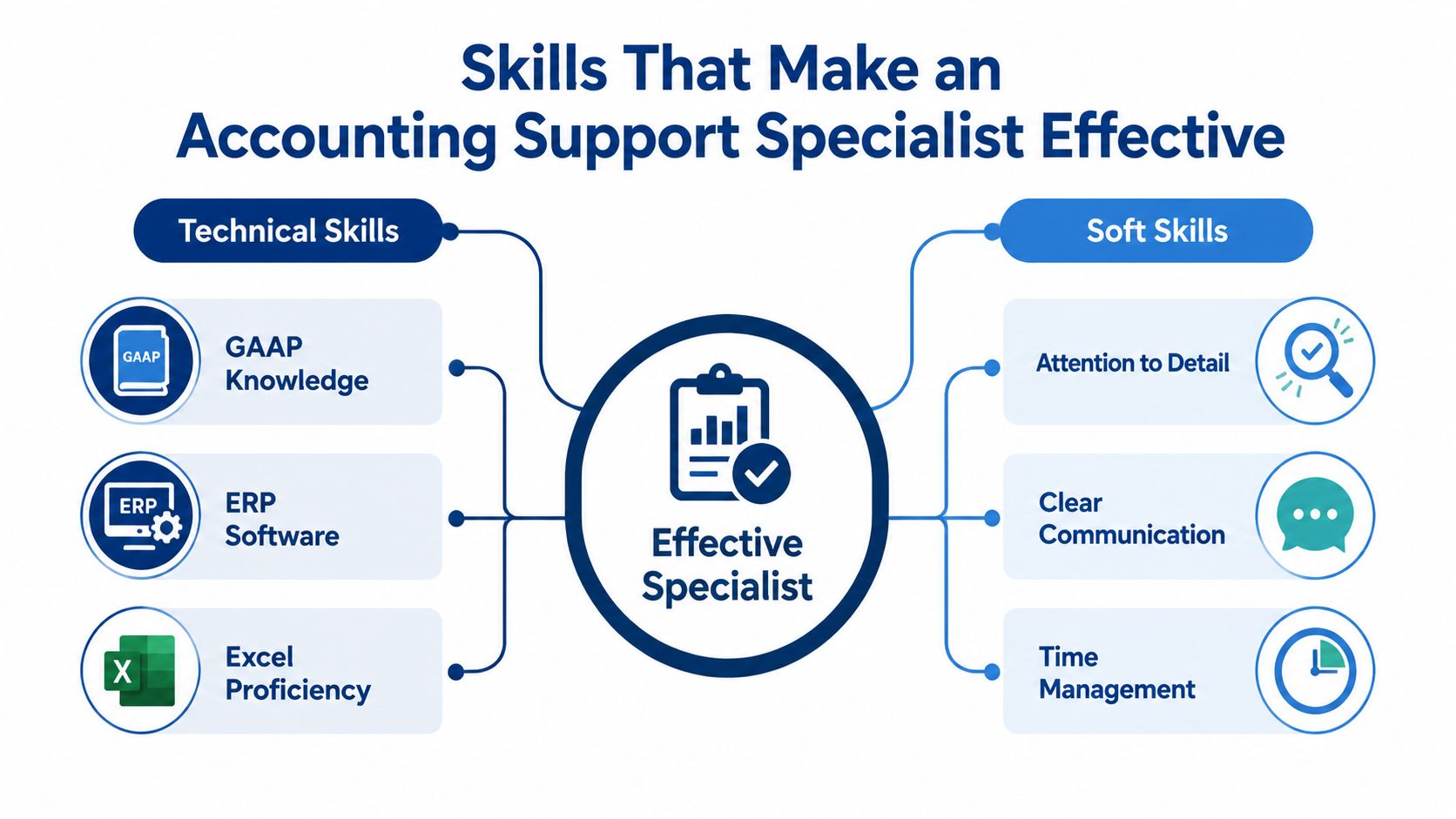
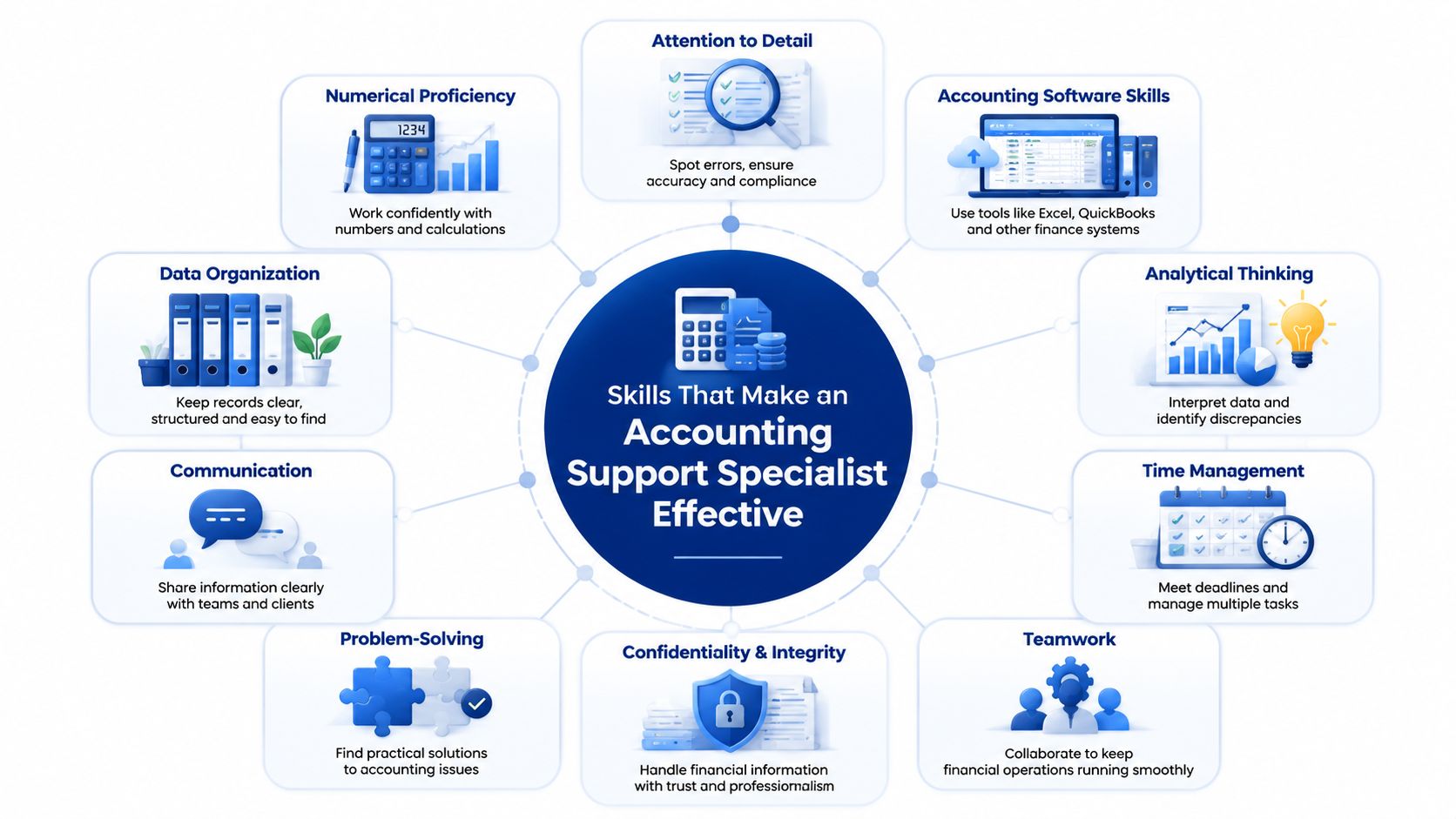
A reliable specialist combines accounting fundamentals with disciplined communication. Tool familiarity alone won't protect cash flow if the person accepts an unexplained variance, codes every charge to the same account, or sends customers unclear payment requests.
Technical competence comes first
The baseline includes practical knowledge of double-entry bookkeeping, reconciliation logic, expense categorization, and GAAP-aligned transaction handling. The specialist doesn't need to act as a CPA or controller, but they must understand what a debit and credit represent, why a bank balance can differ from a ledger balance, and when an item needs escalation.
Look for working fluency in QuickBooks Online, Xero, or Sage, along with spreadsheet skills that include filters, pivot tables, lookups, and basic error checking. Experience with Bill.com, Ramp, or Brex is useful because these systems combine workflow, payments, cards, and documentation.
Other valuable capabilities include:
- Sales tax awareness: The specialist can apply the company's documented rules and flag uncertainty rather than improvising.
- Multi-currency familiarity: They can identify currency differences, fees, and settlement issues for review.
- Payroll integration awareness: They understand how payroll exports and related liabilities flow into the accounting process.
- Data security discipline: They use scoped access, protect customer and vendor information, and avoid sharing financial files through uncontrolled channels.
Judgment shows up in small decisions
The strongest candidates explain what they would investigate before posting a transaction. If a recurring vendor charge has no description, they don't guess. They inspect prior invoices, ask the budget owner, compare the amount with the vendor history, and document the conclusion.
Written communication is equally important. A payment-ready dunning email names the invoice, amount, due date, payment method, and next action. It stays professional without becoming vague or aggressive. During a dispute, the specialist separates the customer's concern from the collection status and routes the commercial decision to the correct owner.
Reliability also means protecting deadlines. Month-end work arrives with competing priorities, so the specialist needs a visible task list, a cutoff calendar, and a habit of flagging blockers early. Curiosity matters more than speed when a reconciliation doesn't balance.
Hiring signal: Ask candidates to describe a time they stopped a transaction because the documentation didn't make sense. You're testing judgment, not just software exposure.
A duplicate invoice caught before payment is more valuable than a fast data-entry session that creates cleanup. Hire for careful investigation, concise updates, confidentiality, and the willingness to say, “I need clarification before I post this.”
In-House vs Remote Staffing Models Compared
There isn't one correct staffing model. The right choice depends on how much transaction work exists, how quickly the backlog needs attention, how much direct supervision the owner can provide, and whether coverage matters when one person is unavailable.
An in-house employee offers proximity and dedicated availability. They can build relationships with sales, operations, and customer service, and they may learn the company's billing patterns quickly. The trade-offs include recruiting, benefits, payroll administration, management time, and the risk that vacation or turnover stops the workflow.
A freelance contractor is useful when the need is narrow or temporary. You can scope a reconciliation project, cleanup assignment, or recurring receivables process without creating a permanent role. The risks are continuity, inconsistent month-end availability, and access control if the contractor works across several clients.
A remote staffing provider offers a middle path. The specialist can work inside the company's recurring processes, while the provider handles recruiting, payroll, and often backup coverage. You give up some direct control over day-to-day staffing decisions, so the arrangement needs a precise scope, reporting cadence, and escalation path.
| Model | Monthly Cost (US) | Control Level | Coverage & Backup | Best Fit |
|---|---|---|---|---|
| In-house employee | Salary and employment costs vary by role and location | High | Usually limited to the individual | Businesses needing dedicated internal collaboration |
| Freelance contractor | Flexible and scope-dependent | Medium | Depends on the contract and availability | Cleanup, projects, or specialized short-term work |
| Remote staffing provider | Retainer or monthly service arrangement | Medium | Provider may support recruiting and continuity | SMBs needing recurring support without a full internal hire |
The BLS reported a $49,210 median annual wage in May 2024 for bookkeeping, accounting, and auditing clerks (BLS featured data). That figure describes the broader occupational category, not a universal hiring price for a specialist, and it doesn't include every employment cost or regional difference.
For a practical comparison of the human and automation trade-offs, review AI-enhanced remote support versus another local hire. The decision rule is straightforward: choose in-house when collaboration and dedicated ownership dominate, freelance when the need is defined and temporary, and a provider when the backlog is recurring but a full employment infrastructure would be excessive.
Hiring Checklist for an Accounting Support Specialist
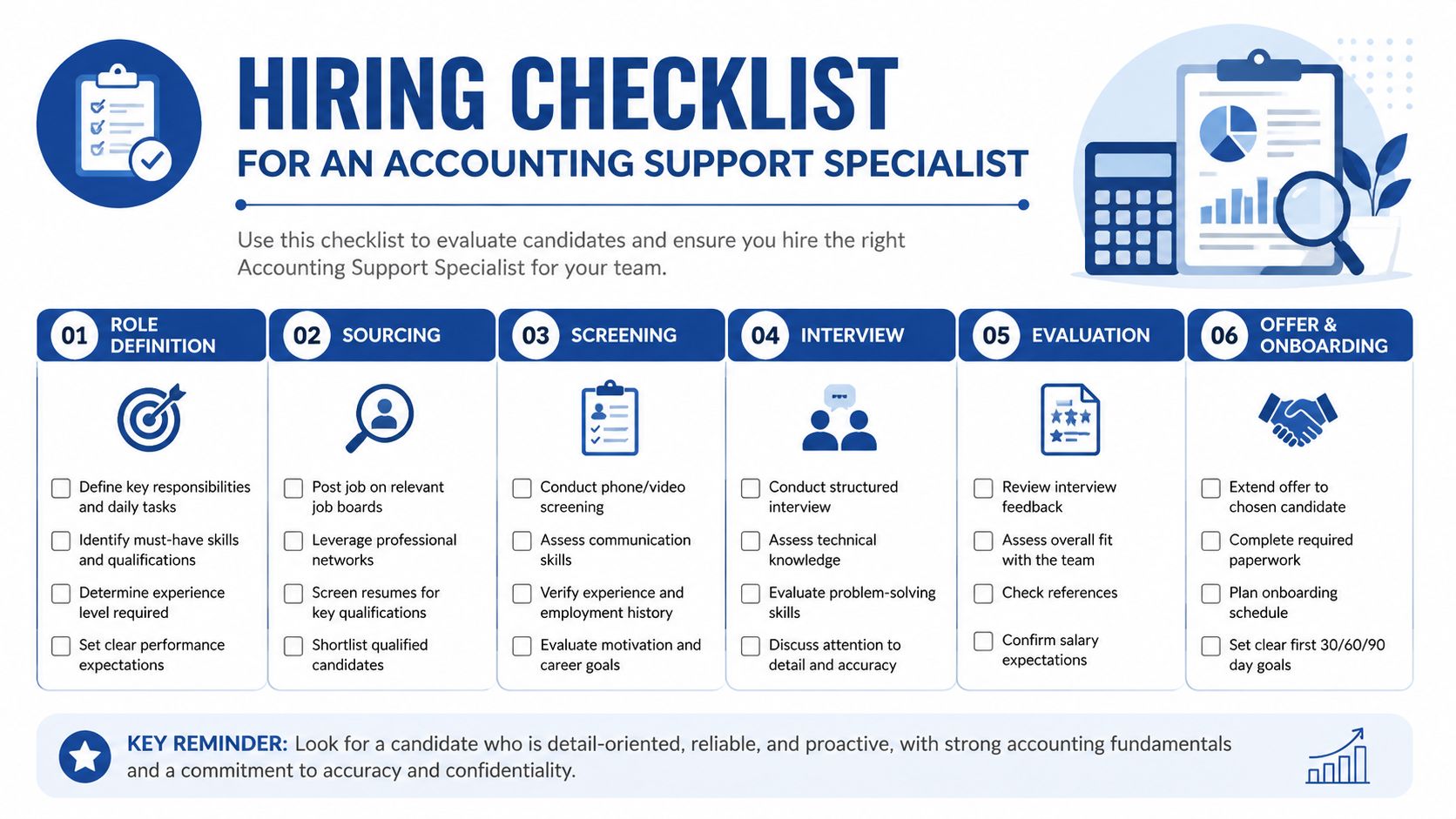
Hire against observable work, not an attractive résumé. The candidate must demonstrate that they can process routine transactions accurately, communicate with customers and vendors, and stop when the records don't support a confident decision.
Pre-screen for evidence
Request a sample report, software certification, or redacted work example that shows how the candidate organizes financial information. Confirm hands-on accounts payable or accounts receivable experience, and ask which systems they used directly rather than which systems they have merely seen.
Check whether the candidate understands sensitive financial data. They should be comfortable with role-based access, secure file handling, and confidentiality expectations. A candidate who treats shared credentials casually is a control risk regardless of technical ability.
Interview for judgment
Use scenarios that force the candidate to explain a process:
- Overdue account: “Walk me through how you'd handle an account that is 90 days overdue.” Listen for invoice verification, payment history review, documented outreach, coordination with the account owner, and escalation.
- Unclear vendor charge: “How would you categorize a recurring vendor charge with no description?” A strong answer includes investigation and documentation, not an unsupported guess.
- Customer dispute: “What would you do if a key customer disputes an invoice?” Look for calm communication, evidence gathering, and separation between operational follow-up and commercial concessions.
Use a paid trial task
A short paid exercise should include invoice entry, a basic reconciliation, and a written dunning email. Grade the work on:
- Accuracy: Are dates, amounts, customers, vendors, and accounts correct?
- Investigation: Did the candidate identify missing or conflicting information?
- Communication: Is the customer message clear, specific, and professional?
- Documentation: Could another team member understand what happened and what remains open?
Don't use a fictional task that tests speed alone. Provide realistic but sanitized records, clear instructions, and a defined review standard.
Onboard with boundaries
Ask references about reliability, confidentiality, response habits, and performance during closing periods. Then provide scoped software access, a chart-of-accounts map, approval thresholds, a written escalation path, and a reporting cadence.
Set a review rhythm tied to operational outcomes such as days sales outstanding, invoice accuracy, reconciliation exceptions, and close readiness. Those measures should show whether the specialist is reducing friction, not merely staying busy.
Next Steps and When to Bring in Outside Support
Start with an audit, not a job post. List every overdue invoice, unfiled receipt, unanswered vendor question, unreconciled transaction, and recurring task that currently belongs to the owner. That inventory tells you whether you need cleanup, recurring coverage, or a broader finance process redesign.
Next, run a paid trial with a candidate or contractor. Judge invoice accuracy, documentation quality, escalation judgment, and movement in collection discipline rather than hours logged. If you need outside perspective on bookkeeping scope, get bookkeeping help from EndureGo Tax as one possible resource for defining the work.
Finally, document the operating rules. Include login permissions, approval thresholds, invoice ownership, customer follow-up standards, receipt requirements, reporting frequency, and the person responsible for unusual items.
Bring in outside support sooner if close deadlines are missed repeatedly, your accountant spends most of their time repairing records, or transaction volume has outgrown the owner's available attention. An accounting support specialist is not merely an administrative expense. Properly scoped, the role is a cash-flow protection layer that keeps routine work moving while qualified accountants focus on higher-judgment responsibilities.
GRIT Virtual Assistants LLC provides AI-enhanced remote accounting support for invoicing, receivables reminders, expense organization, and light bookkeeping administration. If your SMB needs a structured human layer around its finance tools, visit GRIT Virtual Assistants LLC to discuss a supported staffing arrangement.